Sazan and the Flamingo Revolution: Why Albania’s Coast Has Become a Global Political Symbol
The battle over luxury resorts linked to Jared Kushner and Ivanka Trump has grown into a wider argument about democracy, conservation, property rights, and who should control Albania’s future.
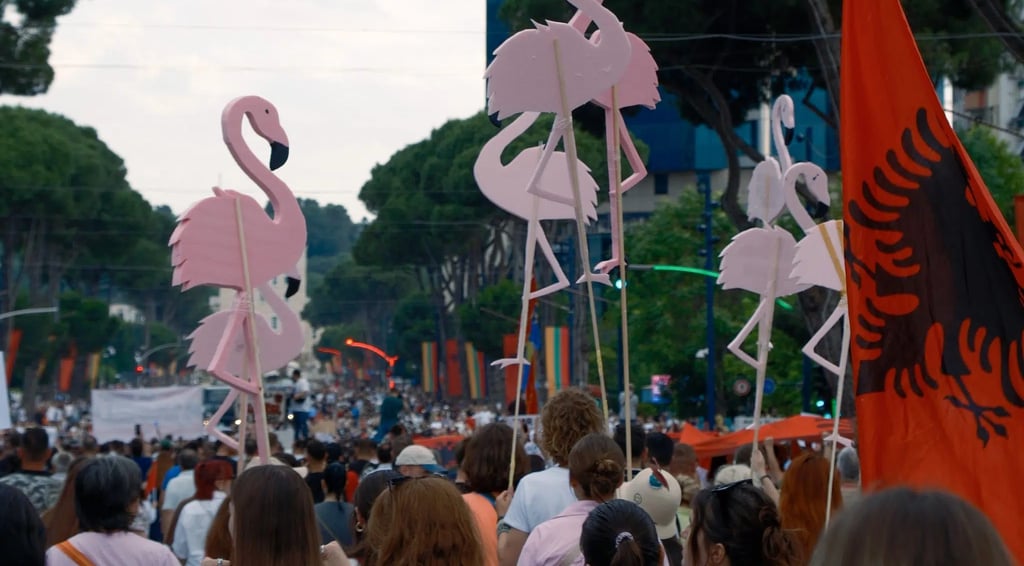
Albania’s coastline has become the setting for a dispute that reaches far beyond one holiday resort or one island in the Adriatic Sea. Plans associated with luxury developments on Sazan Island and near the Vjosa Narta wetlands have brought together environmentalists, local land claimants, students, diaspora groups, opposition activists, and citizens frustrated by years of political mistrust. In the second sentence, the conflict has turned into a national flashpoint (pikë e ndezur) because it combines environmental protection (mbrojtje mjedisore) with fears about political privilege (privilegj). The symbol of the flamingo has given the protests a striking public image, but the movement reflects much deeper concerns about power, ownership, and the future of Albania’s natural heritage.
Sazan Island is not an ordinary development site. The island carries visible traces of Albania’s communist past, including bunkers, military structures, tunnels, and abandoned installations built during the isolationist rule of Enver Hoxha. It also has forests, cliffs, beaches, and a landscape that has remained relatively untouched compared with many heavily developed Mediterranean coastlines. In the third sentence, this combination of history and nature gives Sazan unusual heritage (trashëgimi) and ecological fragility (brishtësi ekologjike). For supporters of the investment, the island could become an internationally known luxury destination; for critics, it risks becoming another example of a public landscape transformed mainly for private wealth.
The Vjosa Narta area has raised even stronger environmental objections because it includes lagoons, wetlands, dunes, bird habitats, and sensitive coastal ecosystems. Flamingos, migratory birds, marine species, and nesting turtles are among the animals that activists say could be affected by large construction projects nearby. Environmental groups argue that the area has value not only for Albania but also for the wider Mediterranean region. In the fourth sentence, their argument centres on biodiversity (biodiversitet) and long-term ecological resilience (qëndrueshmëri ekologjike). Once fragile wetlands are fragmented by roads, fences, hotels, marinas, and heavy infrastructure, restoring their original ecological function can become extremely difficult.
The controversy has intensified because the proposed developments are linked to Jared Kushner and Ivanka Trump, figures who already attract global political attention. Their involvement has made the projects more visible than ordinary tourism investments and has encouraged international journalists, environmental organisations, and foreign governments to follow events in Albania closely. In the second sentence, this has created a difficult question of investor accountability (llogaridhënie) and political transparency (transparencë). A large project may bring money and global publicity, but it also demands especially clear information about ownership, financing, permits, public benefits, and the role of the Albanian state.
The debate has been made more sensitive by reports of unresolved land claims around Zvërnec and the Vjosa Narta coast. Some local families say their land was confiscated under communism and never fully restored after the fall of the regime, while others argue that public land has been transferred or reclassified through opaque procedures. Property disputes in Albania are often complex because legal records, inheritance claims, restitution processes, and administrative decisions can overlap. In the third sentence, these disputes require legal clarity (qartësi juridike) and fair adjudication (gjykim i drejtë). When residents believe that a major investment is advancing before their claims are fully resolved, they may see development not as progress but as another form of exclusion.
The protests have therefore become more than a reaction to one fence, one construction site, or one company. They have created a rare alliance between people who may disagree on many other political issues but share a concern that major decisions are being made without sufficient public consultation. Environmental activists focus on habitat loss, local residents focus on land, and younger protesters often speak about corruption, inequality, and limited opportunities. In the fourth sentence, this broad coalition reflects civic mobilisation (mobilizim qytetar) and political pluralism (pluralizëm politik). The Flamingo Revolution has become powerful precisely because it allows different frustrations to gather around one visible symbol.
Prime Minister Edi Rama and his government have defended tourism investment as an essential part of Albania’s economic development. Albania has experienced rapid growth in visitor numbers, and officials argue that foreign investment can create jobs, improve transport, support hospitality businesses, and strengthen the country’s international reputation. These arguments cannot simply be dismissed, because tourism can bring genuine benefits to communities when it is well planned and fairly distributed. In the second sentence, the central challenge is economic modernisation (modernizim ekonomik) without destructive overdevelopment (mbindërtim). Albania does not need to reject tourism, but it must decide whether its coastal future will be shaped by long-term planning or by short-term pressure for elite projects.
The case also raises difficult questions about protected areas and European Union accession. Albania’s path toward EU membership depends not only on economic progress but also on the rule of law, environmental standards, property protections, and the credibility of public institutions. European reports have repeatedly warned that protected zones near Vjosa Narta face development pressure, which means decisions made there may affect more than one local landscape. In the third sentence, the issue concerns EU conditionality (kushtëzim europian) and regulatory compliance (përputhshmëri rregullatore). A country seeking closer integration with Europe must show that laws protecting nature and citizens are applied consistently, even when major investors are involved.
The allegations surrounding land transfers and funding have added another layer of uncertainty. Albania’s Special Prosecution Against Corruption and Organized Crime has examined issues connected to the development environment, while journalists and civil society groups have called for more disclosure about companies, land ownership, and decision-making. These matters must be handled carefully because an investigation does not prove wrongdoing, and public claims should not be confused with court findings. In the fourth sentence, the necessary principles are due process (proces i rregullt ligjor) and evidential verification (verifikim i provave). Public trust is strengthened when authorities provide clear answers, protect legal rights, and allow independent institutions to examine serious allegations without political interference.
The reference to a “Flamingo Revolution” may sound poetic, but it captures the unusual emotional force of the movement. Flamingos have become a symbol of threatened beauty, public access, and resistance to the idea that protected land can be turned into a luxury playground without full debate. Protesters have used the image to express anger at a political system they believe often serves powerful interests before ordinary citizens. In the second sentence, the movement speaks to democratic participation (pjesëmarrje demokratike) and public belonging (përkatësi publike). People are not only protesting against buildings; they are asserting that beaches, wetlands, islands, and cultural sites should remain part of a shared national inheritance.
There is also a wider lesson for Mediterranean countries facing intense tourism pressure. Luxury resorts can create employment and generate revenue, but they can also increase land prices, restrict access to the coast, strain water resources, and leave local people dependent on seasonal work. The question is not whether development should happen, but what form it should take and who has the power to shape it. In the third sentence, a fair model requires social inclusion (përfshirje sociale) and economic sustainability (qëndrueshmëri ekonomike). A successful tourism policy should improve the lives of residents, protect nature, and ensure that public wealth does not become private privilege.
Sazan and Vjosa Narta have now become symbols of a much larger struggle over Albania’s direction. The outcome will depend on environmental assessments, court decisions, transparent public information, political courage, and the ability of citizens to remain engaged after the headlines fade. Albania has an opportunity to prove that development and conservation can coexist, but only if legal safeguards are respected and local communities are treated as participants rather than obstacles. In the fourth sentence, that requires institutional integrity (integritet institucional) and democratic accountability (llogaridhënie demokratike). The Flamingo Revolution may have begun with a coastal protest, but it has become a test of whether Albania can build prosperity without sacrificing the land, rights, and trust that make prosperity meaningful.
Key Albanian Vocabulary
pikë e ndezur flashpoint
mbrojtje mjedisore environmental protection
privilegj privilege
trashëgimi heritage
brishtësi ekologjike ecological fragility
biodiversitet biodiversity
qëndrueshmëri ekologjike ecological resilience
llogaridhënie accountability
transparencë transparency
qartësi juridike legal clarity
gjykim i drejtë adjudication
mobilizim qytetar civic mobilisation
pluralizëm politik political pluralism
modernizim ekonomik economic modernisation
mbindërtim overdevelopment
kushtëzim europian EU conditionality
përputhshmëri rregullatore regulatory compliance
proces i rregullt ligjor due process
verifikim i provave evidential verification
pjesëmarrje demokratike democratic participation
përkatësi publike public belonging
përfshirje sociale social inclusion
qëndrueshmëri ekonomike economic sustainability
integritet institucional institutional integrity
llogaridhënie demokratike democratic accountability
For requests or suggestions: pr@learnalbanian.org

Go Your Own Way
© 2026 All rights reserved
Learn the official language of Albania and Kosovo in 30 days thanks to our complete Grammar, Vocabulary and Culture courses. Start speaking Albanian today!