
Albania’s Flamingo Protests: Tourism, Property and the Future of a Protected Coast
The dispute over luxury resorts linked to Jared Kushner and Ivanka Trump has become far more than a development controversy. It has exposed tensions over environmental protection, land rights, public trust, and Albania’s path toward European integration.
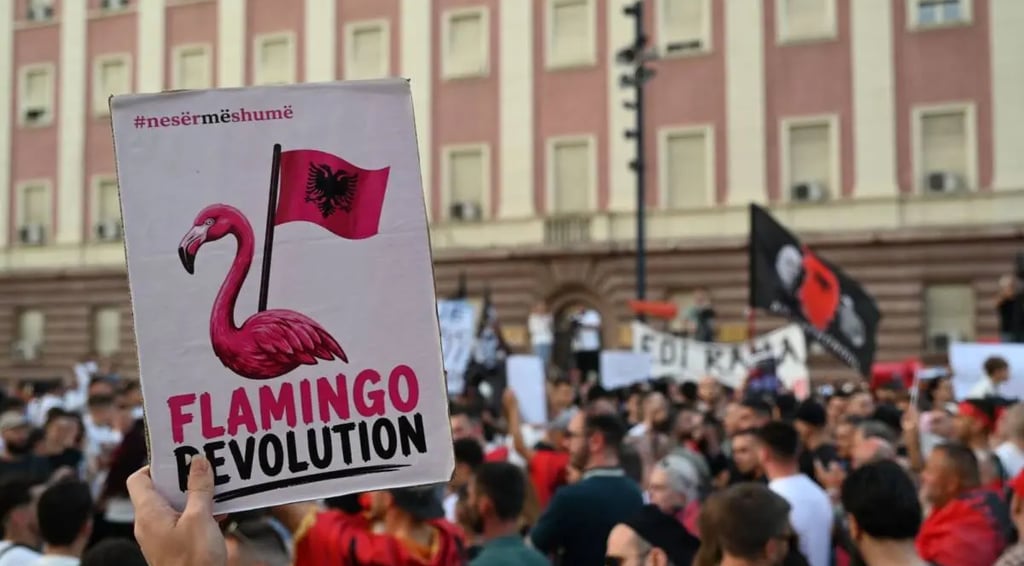
Albania’s planned luxury tourism developments on Sazan Island and near the Vjosa Narta coast have become one of the country’s most serious political controversies in recent years. The projects were promoted as a major opportunity for tourism, investment, and international visibility, but they have also triggered public anger among environmental groups, local residents, opposition figures, and citizens frustrated with political elites. In the second sentence, the dispute became a national flashpoint (pikë e ndezur) because of concerns over public transparency (transparencë) and the government’s broader legitimacy (legjitimitet). What began as an argument over coastal construction has developed into a larger debate about who benefits from Albania’s economic growth and who carries the cost.
The plans involve two highly symbolic locations. Sazan Island, once a tightly controlled military site during Albania’s communist era, has attracted attention because of its dramatic landscape, historic bunkers, and strategic location in the Adriatic Sea. The Vjosa Narta area is even more sensitive because it includes wetlands, dunes, lagoons, and habitats used by migratory birds, sea turtles, and other wildlife. In the third sentence, critics warn that the development could threaten biodiversity (biodiversitet) and weaken the area’s ecological integrity (integritet ekologjik). Supporters, however, argue that carefully planned tourism can create jobs, improve infrastructure, and place Albania among the Mediterranean’s leading high end destinations.
The political conflict has become especially intense because the project is linked to Jared Kushner, the son in law of United States President Donald Trump, and to Ivanka Trump. Their involvement gives the investment an international profile that few Albanian tourism projects could otherwise achieve. It also makes every decision surrounding the project subject to greater scrutiny from foreign media, environmental organisations, and European institutions. In the fourth sentence, the project has therefore become a test of governmental due diligence (kujdesi i duhur) and investor accountability (llogaridhënie). Albania’s leaders argue that major investors should not be discouraged, but critics insist that international prestige cannot replace legal procedures and environmental safeguards.
The controversy grew rapidly after residents and activists raised concerns about land near Zvërnec. Some local families say that the property was confiscated during Albania’s communist period and that their rights were never fully resolved after the fall of the regime. Several residents, including members of the ethnic Greek minority, have brought or supported legal claims connected to the land. In the second sentence, these disputes involve property restitution (kthimi i pronës) and unresolved legal adjudication (gjykim). The issue is emotionally powerful because ownership in post communist Albania is often tied not only to money, but also to family history, displacement, memory, and the search for justice after decades of state confiscation.
Property disputes are particularly difficult because land records may be incomplete, overlapping, or contested by several parties. A government may argue that it has followed official procedures, while residents may believe that historical documents, inheritance rights, or earlier administrative decisions have been ignored. Such conflicts cannot be resolved through political slogans alone. In the third sentence, they require procedural fairness (drejtësi procedurale) and judicial credibility (besueshmëri). If people believe that decisions are made before courts have fully examined their claims, they may see major investments as evidence that wealth and political influence matter more than law.
Environmental organisations have placed the Vjosa Narta wetlands at the centre of their campaign. They argue that the area is significant not only for Albania, but also for the wider Mediterranean ecosystem because it supports migratory birds and fragile coastal habitats. Activists have criticised fencing, early site activity, and changes to legal protections that they believe made large scale tourism development easier in sensitive areas. In the fourth sentence, their objections focus on environmental stewardship (kujdestari mjedisore) and the precautionary principle (parimi i kujdesit). Their argument is that once dunes, lagoons, nesting sites, and wetlands are damaged, it may be impossible to restore them fully, even if developers later promise mitigation.
The Albanian government has defended the projects as part of a broader strategy to transform the country into a global tourism destination. Prime Minister Edi Rama has repeatedly argued that Albania should not reject major investment merely because it is ambitious or politically controversial. His government presents luxury development as a route toward jobs, tax revenue, infrastructure, and a stronger international image. In the second sentence, this approach relies on economic modernisation (modernizim) and tourism diversification (diversifikim). The question is whether Albania can pursue these objectives without repeating a model of uncontrolled coastal construction that has damaged public access, weakened local planning, and created resentment in other parts of the country.
The protests have drawn support from far more than one political group. Environmental campaigners, residents with property claims, students, diaspora activists, nationalists, and citizens concerned about corruption have all found reasons to oppose the project. Their alliances are not always permanent, and their political views are often very different, but they share a belief that the state has not explained the development clearly enough. In the third sentence, this creates an unusual form of civic mobilisation (mobilizim qytetar) and public pluralism (pluralizëm). The flamingo has become an important symbol because it represents both the threatened wetlands and the wider desire to protect a coastline that many Albanians see as a common inheritance.
The demonstrations have also become a broader expression of frustration with Albania’s political system. Many protesters are not only asking questions about one resort, but also criticising a culture in which large projects appear to move faster than ordinary citizens’ concerns about housing, wages, public services, and legal rights. Some activists say that the protests reflect a deeper feeling that economic development is being decided from above rather than shaped through public participation. In the fourth sentence, this sense of exclusion feeds political alienation (tjetërsim politik) and institutional mistrust (mosbesim institucional). When citizens feel that consultation is symbolic rather than meaningful, even a potentially beneficial investment can become a source of anger.
The response from Rama has added another dimension to the dispute. He has defended the developments and argued that critics are influenced by foreign interests, political opponents, or campaigns against Albania’s progress. Some of his remarks have referred to outside interference and hybrid warfare, but these claims have not resolved the domestic concerns raised by local residents and environmental groups. In the second sentence, the use of external scapegoating (fajësim i jashtëm) can distract from legitimate public deliberation (diskutim i arsyetuar). Governments facing protests often search for hidden organisers, but public anger can also arise because citizens genuinely believe that their land, environment, or rights are being threatened.
Albania’s European Union ambitions make the dispute especially important. Environmental standards, public consultation, legal certainty, and the protection of property rights are not merely domestic issues for a country seeking accession. They are also part of the standards that Albania must meet as it moves closer to the European Union. In the third sentence, the controversy raises questions about EU conditionality (kushtëzim europian) and Albania’s regulatory compliance (përputhshmëri rregullatore). The European Commission has repeatedly raised concerns about environmental protection in the wider Vjosa Narta area, meaning that decisions made now could affect Albania’s credibility during accession negotiations.
The dispute also reveals a difficult truth about tourism led development. Tourism can create employment, generate income for local businesses, and encourage investment in transport, hospitality, and cultural heritage. Yet it can also push up property prices, reduce public access to beaches, strain water systems, and leave local people with seasonal or low paid work while profits flow elsewhere. In the fourth sentence, this imbalance can create economic asymmetry (pabarazi ekonomike) and social displacement (zhvendosje shoqërore). A successful tourism strategy must therefore consider not only how many visitors arrive, but whether residents retain meaningful control over the places where they live.
The future of Sazan and Vjosa Narta will depend on more than the outcome of current protests. It will depend on court decisions, environmental assessments, government transparency, investor conduct, and Albania’s willingness to treat local communities as participants rather than obstacles. The most constructive path would involve open publication of agreements, meaningful consultation, protection for lawful property claims, and independent environmental review. In the second sentence, that would strengthen democratic resilience (qëndrueshmëri demokratike) and public confidence (besim publik). Albania does not have to choose between development and conservation, but it must prove that development can be lawful, fair, environmentally credible, and accountable to its own citizens.
Key Albanian Vocabulary
pikë e ndezur flashpoint
transparencë transparency
legjitimitet legitimacy
biodiversitet biodiversity
integritet ekologjik ecological integrity
kujdesi i duhur due diligence
llogaridhënie accountability
kthimi i pronës restitution
gjykim adjudication
drejtësi procedurale procedural fairness
besueshmëri credibility
kujdestari mjedisore stewardship
parimi i kujdesit precautionary principle
modernizim modernisation
diversifikim diversification
mobilizim qytetar civic mobilisation
pluralizëm pluralism
tjetërsim politik alienation
mosbesim institucional mistrust
fajësim i jashtëm scapegoating
diskutim i arsyetuar deliberation
kushtëzim europian conditionality
përputhshmëri rregullatore compliance
pabarazi ekonomike asymmetry
zhvendosje shoqërore displacement
qëndrueshmëri demokratike resilience
besim publik confidence
For requests or suggestions: pr@learnalbanian.org

Go Your Own Way
© 2026 All rights reserved
Learn the official language of Albania and Kosovo in 30 days thanks to our complete Grammar, Vocabulary and Culture courses. Start speaking Albanian today!